
Plan review · Tables
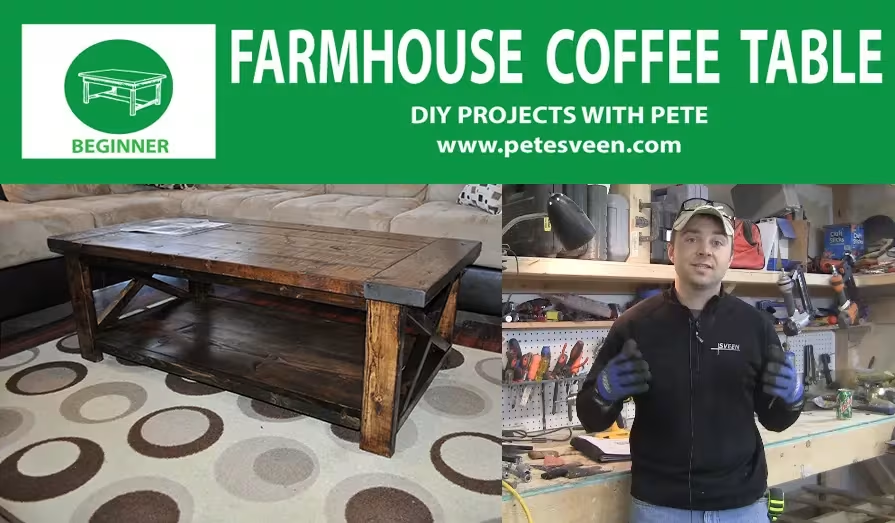
Farmhouse Style Coffee Table
A plan by Pete Sveen · reviewed by ThePlanStack, January 2026
Sturdy ~200 lb coffee table — a clean beginner build.
Sturdy for everyday use — holds ~200 lb with margin to spare.
- Cost$75-$100
- SkillBeginner
- TimeA weekend
- Holds~200 lb
The honest take
What the plan doesn't tell you
• Pine is a softwood; be careful not to overtighten screws (which can strip the wood) or be too aggressive with the sander (which can create dips).
• Assemble the top and base on a dead-flat surface. Any twist in your workbench will transfer directly into the final table, causing it to wobble.
• Double-check your pocket hole jig and drill bit collar settings for the specific thickness of your pine boards. A setting that’s too deep will cause the screw to poke through the other side.
• The final assembled table top will be heavy and awkward. Get help when flipping it over to attach the base to avoid damaging the joints or yourself.
This is a solid, straightforward plan for a farmhouse coffee table. Using pocket screws for the main joinery is practical for this skill level, but make sure your joints are tight and square, as they provide all the structure. The choice of pine fits the rustic look and budget, just be aware it will dent more easily than a hardwood. It's good that the plan provides orientation guidance for every step, as that's key for a clean assembly. Overall, a very buildable project if you work carefully.
Who it's for
Who should build this — and who should skip it
First-timer friendly — a solid early project with no fussy joinery. Built as a living-room coffee table for daily use. Skip it if you need it to carry much past ~200 lb.
The checks
What we checked, and what held
Holds ~200 lb safely
Finished size 18H x 52W x 27D
Comfortably handles normal household use with a sound safety margin.
- Governing member
- Top board
- Material
- Pine
- Cross section
- 5.50 in × 1.50 in
- Orientation
- Flat
- Clear span
- 24.0 in
- Load applied
- 80 lb
- Measured sag
- 0.0066 in
- Working load
- ~200 lb
- Finished weight
- 61.4 lb
Load case ~80 lbs on this member - its share of a ~200 lb load on the whole piece
| Check | Result |
|---|---|
| Bending in the top board — 13% of allowable | PASS |
| Sag in the same member — L/3609 against an L/120 limit | PASS |
| Top Slab 2 | PASS |
| Top Slab 3 | PASS |
| Top Slab 4 | PASS |
| Top Slab 5 | PASS |
Conservative run Checked a second time against stricter standards, the same member reads L/2406 at 20% of allowable — PASS
The structural reality. We checked the part that works hardest here — the pine top board — as a loaded beam over its real working span. Under a realistic in-use load it barely flexes — well within furniture limits, deflecting only about 1/3609 of its span, with bending stress at roughly 13% of what the wood allows. In short, it should feel firm and stay that way.
Solid for its purpose. Our conservative estimate puts the safe working load at ~200 lbs — enough for everyday meals and projects — even someone perching on the edge. Real-world strength depends just as much on assembly: glue every joint, keep the frame square, and drive your fasteners fully home.
These are planning estimates, not a stamped engineering analysis. Wood varies board to board — for anything safety-critical, check with a qualified pro.
Furniture mode, analysis v7.0. Planning estimates — check anything safety-critical with a qualified pro. How we analyze plans.
Build tips
Before you build
- When buying your pine boards, take your time and pick the straightest ones you can find with minimal knots. This will save you a lot of headache during assembly.
- If you plan to stain the table, use a pre-stain wood conditioner. Pine is notorious for absorbing stain unevenly, and this step prevents a blotchy finish.
- Use a large framing square to check that the leg and apron assemblies are exactly 90 degrees before driving the pocket screws home. It's very difficult to fix a crooked frame later.
Reference
Materials & cut list
Lumber & sheet goods
- 2x6x8′ Pine (qty: 4)
- 2x4x8′ Pine (qty: 2)
- 2x2x8′ Pine (qty: 3)
- 1x12x8′ Pine (qty: 1)
Hardware
- 2-1/2 in Kreg screws (qty: 1 box)
- 1-1/4 in Kreg screws (qty: 1 box)
- 2-1/2 in wood screws (qty: 16)
- Finish nails
- 120, 220, and 400 grit sandpaper
- Wood stain
- Semi-Gloss Polyurethane
View Full Cut List & Materials
| Part Name | Qty | Dimensions | Material |
|---|---|---|---|
| Top | 5 | 41" x 5.5" x 1.5" | 2x6 Pine |
| Breadboards | 2 | 29" x 5.5" x 1.5" | 2x6 Pine |
| Legs | 4 | 16.5" x 3.5" x 1.5" | 2x4 Pine |
| Shelf | 2 | 41" x 11.25" x 0.75" | 1x12 Pine |
| Side Rails | 4 | 41" x 1.5" x 1.5" | 2x2 Pine |
| End Rails | 4 | 22.5" x 3.5" x 1.5" | 2x4 Pine |
| X Support (Long) | 2 | 22.5" x 1.5" x 1.5" | 2x2 Pine |
| X Support (Short) | 4 | 11.25" x 1.5" x 1.5" | 2x2 Pine |
Cut List Calculator
Cut List Calculator
Calculating optimal cuts...
| Part | Qty | Length | Width | Material |
|---|
Original plan
About this design
This design is Pete Sveen’s work, not ours. We review free DIY plans and add the engineering: load paths, spans, joints, and the fixes worth making before you cut. We do not republish the build instructions. For the steps, the photographs and the author’s own notes, go to the source.
Keep looking
Other plans to compare
We have reviewed these builds too: