
Plan review · Outdoor
Outdoor Sofa Plans
A plan by Ana White · reviewed by ThePlanStack, January 2026
Good outdoor sofa for ~400 lb — solid for normal use, just don't overload it.
Solid for normal use — holds ~400 lb; just don't overload it.
- Cost$75-$125
- SkillIntermediate
- TimeA weekend
- Holds~400 lb
The honest take
What the plan doesn't tell you
• A 75-inch frame is tough to keep square. Use clamps and a large framing square during assembly, especially when attaching the seat base to the sides.
• Cedar is a softwood. It’s easy to overtighten pocket screws and strip the wood or crack the board, so set your drill’s clutch to a lower setting.
• The plans require a jigsaw or bandsaw, likely for the arms. Practice any curved cuts on scrap wood first to get them clean and consistent on both sides.
• This sofa will be heavy once assembled. Build it near its final location or make sure you have help ready to move it without straining the joints.
This is a decent plan for an outdoor sofa. Using pocket screws makes the assembly fast, but you need to be precise with your jig settings in a softwood like cedar to get a strong joint. The choice of cedar is spot-on for outdoor durability. I'm glad to see the plan includes specific orientation guidance in 5 of the 6 steps; that's critical for preventing mistakes on a large frame. It's a solid intermediate project— just don't rush the main frame assembly.
Who it's for
Who should build this — and who should skip it
A good step-up build — fine if you've made a few things and own a drill/driver and a way to cut straight. Patio/deck seating roomy enough for two. Skip it if you need it to carry much past ~400 lb.
The checks
What we checked, and what held
Holds ~400 lb safely
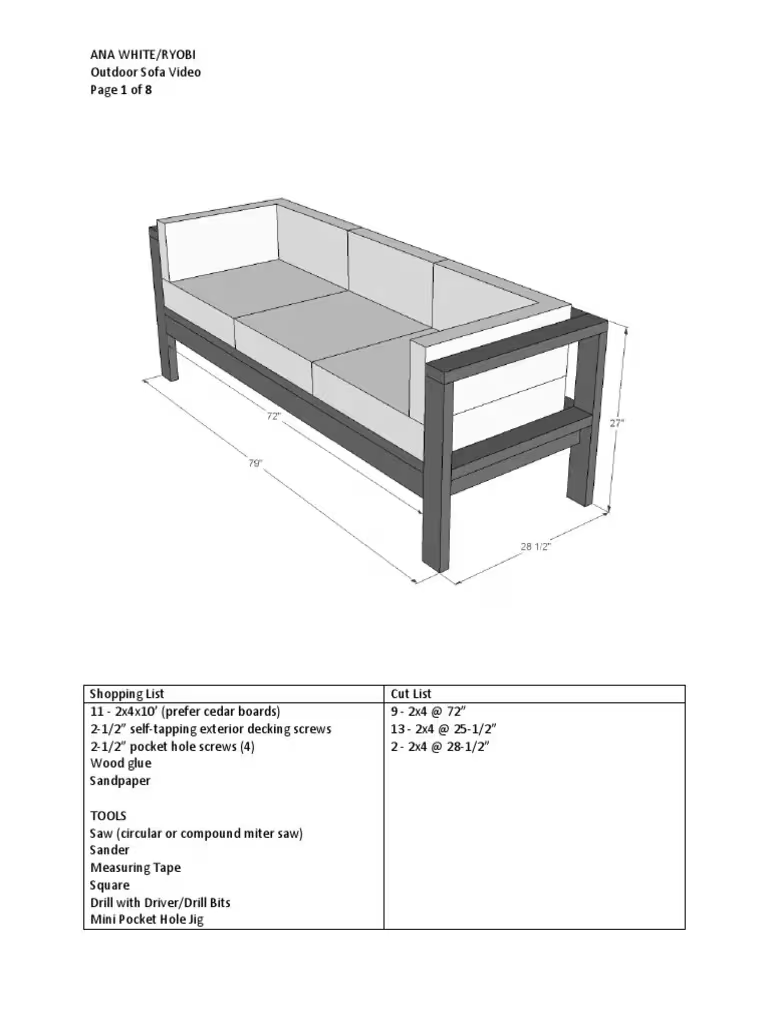
Finished size 31.5H x 75W x 33D
Suitable for light household use; avoid concentrated overloading.
- Governing member
- Seat frame rail (between supports)
- Material
- Pine
- Cross section
- 1.50 in × 3.50 in
- Orientation
- On edge
- Clear span
- 34.0 in
- Load applied
- 160 lb
- Measured sag
- 0.0594 in
- Working load
- ~400 lb
- Finished weight
- 70.4 lb
Load case ~160 lbs on this member - its share of a ~400 lb load on the whole piece
| Check | Result |
|---|---|
| Bending in the seat frame rail (between supports) — 59% of allowable | PASS |
| Sag in the same member — L/572 against an L/120 limit | PASS |
| Back Slat 2 | PASS |
| Back Slat 3 | PASS |
| Back Slat 4 | PASS |
| Seat Slat 1 | PASS |
| Tip-over resistance, unloaded — ratio 1.55 against a 1.0 target | PASS |
Conservative run Checked a second time against stricter standards, the same member reads L/381 at 89% of allowable — PASS
The structural reality. We checked the part that works hardest here — the pine seat frame rail — as a loaded beam over its real working span. Under a realistic in-use load it barely flexes — well within furniture limits, deflecting only about 1/572 of its span, with bending stress at roughly 59% of what the wood allows. In short, it should feel firm and stay that way.
Sound for normal use — just don’t overload it. Our conservative estimate puts the safe working load at ~400 lbs — enough for an adult sitting down with margin to spare. Real-world strength depends just as much on assembly: glue every joint, keep the frame square, and drive your fasteners fully home.
These are planning estimates, not a stamped engineering analysis. Wood varies board to board — for anything safety-critical, check with a qualified pro.
Furniture mode, analysis v7.0. Planning estimates — check anything safety-critical with a qualified pro. How we analyze plans.
Build tips
Before you build
- Even though the plan doesn't specify it, use an exterior-rated wood glue with the pocket screws on all structural joints. It will add significant long-term strength and rigidity.
- Assemble the main frame on a flat, level surface like a garage floor. This is the best way to ensure the finished sofa sits flat and doesn't rock.
- Sand all your individual pieces after cutting and before assembly. It's much harder to get into the corners and tight spots once the sofa is put together.
Reference
Materials & cut list
Lumber & sheet goods
- 2x4x8′ (qty: 4)
- 2x6x8′ (qty: 1)
- 1x6x8′ (qty: 1)
- 1x4x8′ (qty: 1)
- 1x2x8′ (qty: 1)
Hardware
- 2-1/2 in Exterior Pocket Hole Screws (qty: 50)
- 1-1/4 in Exterior Pocket Hole Screws (qty: 100)
- Exterior Wood Glue
- Exterior Wood Finish
View Full Cut List & Materials
| Part Name | Qty | Dimensions | Material |
|---|---|---|---|
| Back Legs | 2 | 27.5" x 5.5" x 1.5" | 2x6 |
| Front Legs | 2 | 21.5" x 5.5" x 1.5" | 2x6 |
| Arm Rests | 2 | 29.5" x 5.5" x 1.5" | 2x6 |
| Seat Frame (Front/Back) | 2 | 68" x 3.5" x 1.5" | 2x4 |
| Seat Frame (Sides) | 2 | 24" x 3.5" x 1.5" | 2x4 |
| Seat Frame (Middle Support) | 2 | 24" x 3.5" x 1.5" | 2x4 |
| Back Support (Top/Bottom) | 2 | 68" x 3.5" x 1.5" | 2x4 |
| Back Slats | 4 | 68" x 5.5" x 0.75" | 1x6 |
| Seat Slats | 5 | 25.5" x 5.5" x 0.75" | 1x6 |
Cut List Calculator
Cut List Calculator
Calculating optimal cuts...
| Part | Qty | Length | Width | Material |
|---|
Original plan
About this design
This design is Ana White’s work, not ours. We review free DIY plans and add the engineering: load paths, spans, joints, and the fixes worth making before you cut. We do not republish the build instructions. For the steps, the photographs and the author’s own notes, go to the source.
Keep looking
Other plans to compare
We have reviewed these builds too: