
Plan review · Storage
Bracket Open Shelving
A plan by Corey · reviewed by ThePlanStack, January 2026
Good ~50-lb-per-shelf wall shelving — anchor it, and confirm whether it's 1× or 2× stock (the plan contradicts itself).
Sturdy for everyday use — holds ~50 lb with margin to spare — and it tips easily, so read the tip-over note below.
- Cost$50-$100
- SkillBeginner
- TimeA weekend
- Holds~50 lb
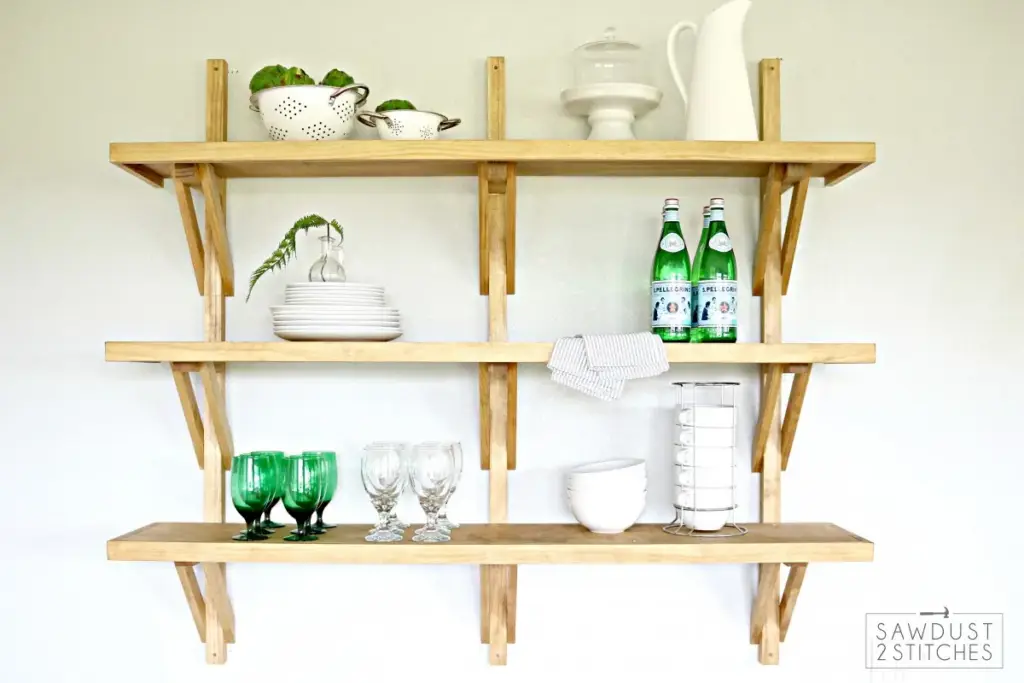
The honest take
What the plan doesn't tell you
• The structural integrity depends entirely on the brackets. Make sure your cuts are exact and that each bracket assembly is perfectly square before moving on.
• With 42 total pieces, it’s easy to grab the wrong part. Label every piece with a pencil right after you cut it to avoid mistakes during assembly.
• This unit is 48 inches wide and will get heavy. You must secure it directly to wall studs using long screws; drywall anchors alone will not be safe or sufficient.
• Pine is a softwood and splits easily. Pre-drilling and using the countersink bit mentioned in the tool list is not optional, especially when driving screws near the end of a board.
This is a decent plan for a beginner. The joinery, relying on wood glue and screws, is straightforward but you'll need to be precise to ensure the shelves can handle weight. Pine or Poplar is the right call for this build since it's affordable and paints well. The plan's specific orientation guidance for three of the steps is important—follow it closely to get the brackets right. With 42 pieces, it's more about careful repetition than complex skill, so stay organized.
Who it's for
Who should build this — and who should skip it
First-timer friendly — a solid early project with no fussy joinery. Wall/standing shelving for books and decor. Skip it if you need it to carry much past ~50 lb — and treat it as a piece to anchor to the wall, not a free-standing one.
The checks
What we checked, and what held
Holds ~50 lb safely
Finished size 36H x 48W x 11.25D
Comfortably handles normal household use with a sound safety margin.
- Governing member
- Shelf (span between brackets)
- Material
- Plywood
- Cross section
- 11.25 in × 0.75 in
- Orientation
- Flat
- Clear span
- 24.0 in
- Load applied
- 50 lb
- Measured sag
- 0.0152 in
- Working load
- ~50 lb
- Finished weight
- 70.3 lb
Load case ~50 lbs per shelf
| Check | Result |
|---|---|
| Bending in the shelf (span between brackets) — 9% of allowable | PASS |
| Sag in the same member — L/1582 against an L/120 limit | PASS |
| Front Middle Shelf Front Edging | PASS |
| Front Bottom Shelf Front Edging | PASS |
| Top Shelf | PASS |
| Middle Shelf | PASS |
| Tip-over resistance, unloaded — ratio 0.53 against a 1.0 target | ADVISORY |
Conservative run Checked a second time against stricter standards, the same member reads L/1055 at 13% of allowable — PASS
Install anti-tip hardware (wall anchor)
Alternative: Add 60 lbs ballast to base
The structural reality. We checked the part that works hardest here — the plywood shelf — as a loaded beam over its real working span. Under a realistic in-use load it barely flexes — well within furniture limits, deflecting only about 1/1582 of its span, with bending stress at roughly 9% of what the wood allows. In short, it should feel firm and stay that way.
Solid for its purpose. Our conservative estimate puts the safe working load at ~50 lbs per shelf — enough for books and everyday household storage. Real-world strength depends just as much on assembly: glue every joint, keep the frame square, and drive your fasteners fully home.
These are planning estimates, not a stamped engineering analysis. Wood varies board to board — for anything safety-critical, check with a qualified pro.
Furniture mode, analysis v7.0. Planning estimates — check anything safety-critical with a qualified pro. How we analyze plans.
Build tips
Before you build
- Cut all your identical parts in batches to ensure they are consistent. Sanding all 42 pieces before you start assembling will save you a lot of hassle later.
- When assembling the brackets, create a simple jig from scrap wood to hold the parts in place. This guarantees every bracket is identical, which is critical for getting the shelves level.
- Use spacer blocks cut from scrap to set the distance between shelves during assembly. It's faster and more accurate than measuring each placement individually.
Reference
Materials & cut list
Lumber & sheet goods
- 1x6x8′ board (qty: 3)
- 1x4x8′ board (qty: 1)
- 1x2x8′ board (qty: 1)
- 3/4 in plywood sheet 2×4 (qty: 1)
Hardware
- 2-1/2 in wood screws (qty: 12)
- 4 in wood screws (for mounting) (qty: 12)
- 2 in wood screws (qty: 24)
- 1-1/2 in 18ga brad nails (qty: 50)
- 1-1/2 in 16ga finish nails (qty: 75)
- Wood glue
- Wood filler
View Full Cut List & Materials
| Part Name | Qty | Dimensions | Material |
|---|---|---|---|
| Vertical Base | 3 | 48" x 5.5" x 1.5" | 2x6 |
| Horizontal Shelf Support | 9 | 11.25" x 3.5" x 1.5" | 2x4 |
| Diagonal Support | 18 | 10.25" x 3.5" x 1.5" | 2x4 |
| Shelf | 3 | 60" x 11.25" x 0.75" | 3/4 Plywood |
| Shelf Edging (Front) | 3 | 60" x 1.5" x 0.75" | 1x2 |
| Shelf Edging (Sides) | 6 | 11.25" x 1.5" x 0.75" | 1x2 |
Cut List Calculator
Cut List Calculator
Calculating optimal cuts...
| Part | Qty | Length | Width | Material |
|---|
Original plan
About this design
This design is Corey’s work, not ours. We review free DIY plans and add the engineering: load paths, spans, joints, and the fixes worth making before you cut. We do not republish the build instructions. For the steps, the photographs and the author’s own notes, go to the source.
Keep looking
Other plans to compare
We have reviewed these builds too: